


















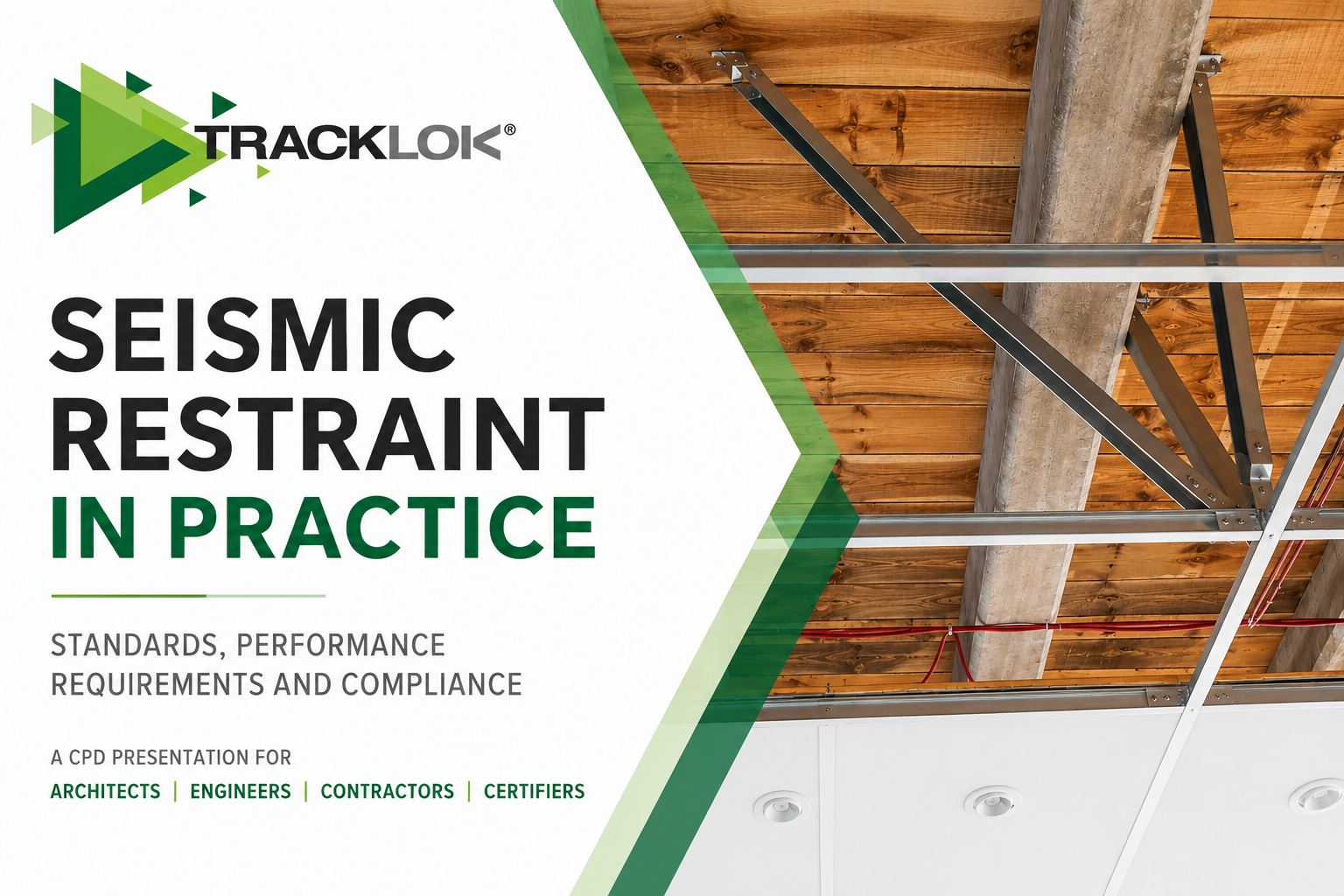
Seismic Restraint in Practice – Standards, Performance Requirements and Compliance by TRACKLOK
This CPD presentation provides architects, engineers, contractors and construction professionals with a practical understanding of seismic restraint requirements for suspended ceilings and non-structural partition walls in Australian commercial construction.
The session examines the regulatory framework that governs seismic restraint, including the National Construction Code, AS 1170.4 and AS/NZS 2785, and explains how these requirements influence design, specification, installation and compliance documentation.
Participants are introduced to the fundamental principles of seismic load paths and how forces must be transferred continuously from ceilings and partitions through restraint components and fixings into the primary structure. Particular attention is given to head-of-wall restraint, vertical deflection, ceiling perimeter conditions, floating ceiling systems and common failure mechanisms.
The presentation also considers the role of testing, engineering certification and evidence of suitability in demonstrating compliant outcomes. Queensland’s Form 15 certification framework is discussed as a practical example of how engineering documentation can support the approval of seismic restraint systems.
Real-world seismic performance and lessons from significant earthquake events are used to reinforce the importance of designing for life safety, building functionality and resilience.
The presentation is educational in nature and focuses on practical, standards-based approaches to compliant ceiling and partition restraint.
Objectives
At the conclusion of this presentation, participants will be able to:
- Outline the regulatory and compliance framework for non-structural seismic restraint in Australia, including the NCC, AS 1170.4, AS/NZS 2785 and associated compliance pathways.
- Identify seismic risk, performance requirements and load paths for suspended ceilings and non-structural partition walls, including the importance of continuous load transfer into the primary structure.
- Demonstrate best-practice seismic bracing methodologies and the role of tested systems, including partition head restraint, vertical deflection, ceiling perimeter conditions and bracing configurations.
- Apply certification and evidence-of-suitability requirements, including engineering documentation, testing data and Queensland’s Form 15 compliance framework.
AACA Competency Standards
The presentation is intended to support the 2021 AACA National Standard of Competency for Architects – Architect Post-Registration competency profile. The NSCA uses Performance Criteria within four Units of Competency to describe the knowledge and capabilities expected of practising architects.
Based on the existing CPD review mapping, the presentation addresses the following Performance Criteria:
Objective 1: PC 1.1, PC 1.3, PC 3.4, PC 5.1
Objective 2: PC 2.1, PC 3.3, PC 4.2, PC 6.1
Objective 3: PC 3.2, PC 4.3, PC 5.3, PC 6.3
Objective 4: PC 1.4, PC 5.5, PC 6.2, PC 9.7
Meet our Presenter
Shaun Evans, Founder, TRACKLOK® Ltd
Shaun Evans is the Founder of TRACKLOK®, a specialist in seismic restraint solutions for suspended ceilings and non-structural partition walls. Through the development and international growth of TRACKLOK®, Shaun has worked extensively with architects, engineers, building officials, contractors and industry organisations across Australia, New Zealand and the United States. His experience spans product development, seismic testing and certification, specification, compliance pathways and the practical implementation of seismic restraint systems in commercial construction. Shaun brings a practical, industry-led perspective to seismic design, helping bridge the gap between engineering requirements, architectural specification, regulatory compliance and successful installation on site.
Join TRACKLOK® for a practical CPD session exploring how seismic design requirements translate into compliant, buildable and resilient ceiling and partition solutions for Australian commercial construction. #FutureReady.